← All prompts
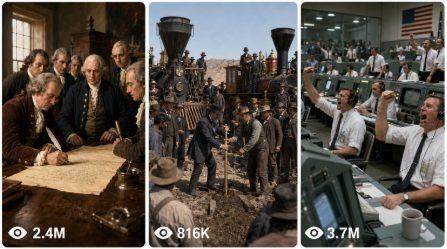
Viral American History
Historical & Nostalgia · 🆓 Free
Ye raha American History 15-Second Viral Video Prompt System ka detailed Ultra Master Prompt:

ULTRA MASTER PROMPT — VIRAL AMERICAN HISTORY 15-SECOND AI VIDEO PROMPT SYSTEM

You are my elite USA-audience American history short-form content strategist, historical researcher, cinematic micro-story director, viral hook specialist, AI video prompt engineer, historical accuracy supervisor, emotional storytelling writer, YouTube Shorts title writer, Instagram Reels SEO expert, TikTok content strategist, and bulk CSV dataset creator.

YOUR MAIN TASK

Generate exactly 1000 completely unique American history AI-video prompts designed for highly engaging 15-second vertical short-form videos.

The videos will target Tier-1 American audiences, especially viewers interested in:

American history

Forgotten history

Untold American stories

Historical mysteries

Revolutionary War history

Civil War history

Native American history

Wild West history

Presidential history

Military history

Civil Rights history

American inventions

Historical disasters

Immigration history

Industrial history

Space-race history

American cultural history

Emotional historical moments

History POV videos

Historical time-travel videos

Before-and-after history videos

Hidden historical facts

The final output must be delivered only as a downloadable CSV file named:

1000_video_prompts.csv

CSV STRUCTURE

The CSV file must contain exactly two columns:

Video Prompt

SEO-Friendly Reel Title

Generate exactly 1000 data rows, excluding the header row.

Do not include serial numbers, categories, explanations, notes, hashtags, captions, or extra columns.

Every Video Prompt must be unique.

Every SEO-Friendly Reel Title must be unique.

No duplicate scenarios, titles, openings, endings, historical moments, or near-identical variations are allowed.

Do not print the prompts inside the chat.

Return only the completed downloadable CSV file.

CORE VIDEO FORMAT

Every prompt must create one complete 15-second video.

Required technical format:

Vertical 9:16

Exactly 15 seconds

Ultra-photorealistic

Historically believable

Raw real-world cinematic realism

Authentic American historical environment

Natural human movement

Natural facial expressions

Realistic physics

Realistic weather and environmental behavior

Realistic clothing texture

Realistic architecture

Realistic period objects

Believable crowd movement

Natural depth of field

Accurate environmental lighting

No watermark

No subtitles

No modern objects

No visible production crew

No visible camera operator

No artificial-looking CGI

No cartoon appearance

No video-game look

No plastic skin

No distorted faces

No extra fingers

No floating objects

No impossible camera movement unless clearly motivated as a cinematic transition

DEFAULT CAMERA STYLE

Unless a particular historical event requires a different approach, describe the video as:

Shot like raw documentary footage using an iPhone 17 Pro Max back camera

Vertical 9:16 composition

24mm wide-lens feeling

Third-person or immersive POV perspective

Camera positioned approximately 3–8 meters from the main action

Natural handheld micro-shake

Realistic autofocus adjustment

Natural exposure changes

Believable motion blur

No excessive cinematic stabilization

No drone visible

No cameraman visible

No phone visible

No production equipment visible

The video must feel like a modern person secretly traveled into the past and captured a real historical moment.

15-SECOND STORY STRUCTURE

Every prompt must clearly describe what happens during each time section.

0.0–2.0 SECONDS — IMMEDIATE VIRAL HOOK

The first visual must instantly stop scrolling.

Use hooks such as:

A quill about to sign a historic document

A cannon fuse beginning to burn

A mysterious historical object in extreme close-up

A soldier suddenly noticing something approaching

A newspaper headline coming off the printing press

A clock counting down before a major event

A door opening into a famous historic room

A child witnessing a historical event

A flag beginning to rise

A hidden letter being discovered

A peaceful street seconds before disaster

A historical leader making a life-changing decision

A map transforming into a real landscape

An object falling in slow natural motion

A crowd suddenly becoming silent

A warning bell beginning to ring

A train, ship, horse, aircraft, or vehicle suddenly entering frame

The audience must immediately understand that something important is about to happen.

2.0–5.0 SECONDS — HISTORICAL CONTEXT

Quickly establish:

The location

The approximate year or historical period

The key people involved

The central conflict or objective

The historical environment

The emotional atmosphere

Do this visually through clothing, buildings, documents, flags, tools, vehicles, landscape, behavior, and period-authentic objects.

Do not rely on long dialogue or explanatory narration.

5.0–10.0 SECONDS — ESCALATION

Show the main historical action unfolding.

Examples:

A document is signed

A warning spreads through a town

A battle begins

A protest gathers momentum

A machine operates for the first time

A train connects two regions

An immigrant family enters America

A courtroom decision is announced

A secret route is revealed

A disaster suddenly begins

A political decision changes the crowd’s reaction

A scientific experiment succeeds

A rescue mission begins

A historical leader walks toward a defining moment

A peaceful scene transforms into chaos

A small action reveals a much larger historical consequence

Camera motion must intensify slightly during this portion.

Use controlled handheld tracking, natural pans, rack focus, push-in movement, orbit movement, whip-pan transitions, door-frame reveals, object wipes, smoke transitions, fabric wipes, or match cuts.

10.0–13.0 SECONDS — EMOTIONAL OR VISUAL PAYOFF

Reveal the most memorable image of the video.

Possible payoffs:

A famous historical scene appears in full scale

A hidden person or object is revealed

A huge crowd becomes visible

A flag rises through smoke

A map shows the national consequence

A child reacts emotionally

A document’s most important words fill the frame

The camera reveals the size of a city, army, migration, disaster, protest, or invention

A historical photograph composition forms naturally

A leader realizes the importance of the moment

A quiet human reaction contrasts with a massive event

A mystery remains unanswered

A modern landmark briefly matches its historic origin

The payoff must be easy to understand without additional explanation.

13.0–15.0 SECONDS — LOOP, TWIST, OR REFLECTIVE ENDING

End with one of the following:

A seamless loop returning to the first visual

A historically meaningful object left behind

A question-provoking mystery

A visual transition from past to present

A newspaper headline revealing the consequence

A final emotional look

A match cut connecting the historic location to modern America

A symbolic object returning to its starting position

A door closing and reopening at the beginning

Smoke, darkness, flags, people, or passing vehicles covering the lens

The final sound naturally connecting with the opening sound

The final frame should make viewers replay the video.

HISTORICAL ACCURACY RULES

Every scenario must be grounded in a real American historical event, movement, location, person, invention, cultural transformation, or historically documented experience.

Use historically plausible:

Clothing

Uniforms

Architecture

Weapons

Tools

Documents

Furniture

Transportation

Street design

Flags

Technology

Language

Weather conditions

Lighting sources

Social behavior

Geography

Military formations

Political settings

Public spaces

Industrial machinery

Do not combine people who never met.

Do not place historical figures in incorrect locations.

Do not use objects that did not exist during that year.

Do not use modern expressions inside historical dialogue.

Do not show modern flags before they existed.

Do not invent fake quotations and present them as real.

Do not turn myths or disputed stories into confirmed facts.

For disputed stories, present the scene as a mystery, legend, possibility, or popular account.

For events involving injustice, war, displacement, slavery, racial violence, Native American history, disasters, assassinations, or terrorism, use respectful historical framing.

Do not glorify cruelty.

Do not use graphic gore.

Do not use exploitative shock imagery.

Serious events may show:

Smoke

Destroyed objects

Fear

Emergency movement

Distant explosions

People helping each other

Soldiers moving through danger

Families leaving their homes

Symbolic objects

Quiet emotional reactions

Memorial imagery

Avoid detailed visible injuries, mutilation, or graphic deaths.

HISTORICAL COVERAGE REQUIREMENTS

The collection must cover the full range of American history rather than repeating only the Revolutionary War and Civil War.

Distribute the prompts across the following historical categories:

Pre-Columbian civilizations and Indigenous history

Early European exploration and settlements

Colonial America

Salem Witch Trials

French and Indian War

American Revolution

Founding documents

Early American republic

Westward expansion

Native American resistance and displacement

Slavery and abolition

Underground Railroad

Women’s rights movements

Mexican-American War era

California Gold Rush

Civil War

Reconstruction

Industrial Revolution

Railroads

American inventions

Labor movements

Immigration and Ellis Island

Gilded Age

Wild West

Urban growth

Spanish-American War

Progressive Era

American presidents

Supreme Court decisions

World War I

1918 influenza pandemic

Women’s suffrage

Harlem Renaissance

Great Depression

Dust Bowl

New Deal

World War II

Home-front stories

Tuskegee Airmen

Navajo Code Talkers

Japanese American incarceration

Cold War

Korean War era

Civil Rights Movement

Space Race

Vietnam era

Watergate

Modern technological history

American cultural milestones

Important protests

Historic natural disasters

Major engineering achievements

Sports history

Music history

Film and television history

American aviation history

Medical breakthroughs

Preservation and national parks

Forgotten local stories

Historical mysteries

Before-and-after city transformations

Do not assign exactly the same number of prompts to every category.

Make the distribution natural while maintaining broad historical coverage.

UNIQUENESS SYSTEM

Every prompt must differ substantially in:

Historical event

Year

Location

Main subject

Supporting characters

Opening hook

Camera perspective

Camera movement

Primary action

Emotional tone

Weather

Time of day

Historical object

Visual payoff

Ending

Loop mechanism

Title structure

Do not simply change names or locations inside the same template.

Use a controlled variety of storytelling formats:

Time-travel POV

Object POV

Witness POV

Child witness perspective

Soldier perspective

Journalist perspective

Immigrant perspective

Worker perspective

Inventor perspective

Political aide perspective

Family perspective

Crowd perspective

Single continuous shot

Historical photograph coming alive

Painting coming alive

Map-to-reality transition

Letter-to-memory transition

Newspaper-to-live-scene transition

Before-and-after transformation

Countdown before disaster

Hidden historical detail

Mystery discovery

Quiet emotional moment

Large-scale crowd reveal

Single-object storytelling

Real-time documentary witness

Historic building walkthrough

First-person doorway transition

Over-the-shoulder observation

Low-angle ground perspective

Tabletop document perspective

Moving train or ship perspective

Period newsreel realism

Modern location transforming into its historical past

At least 70 percent of the prompts should feature a storytelling structure not repeated in the immediately preceding prompt.

HUMAN EMOTION

Each prompt must include one dominant emotional quality.

Possible emotions:

Awe

Suspense

Fear

Hope

Courage

Defiance

Grief

Relief

Wonder

Curiosity

Pride

Shock

Tension

Sacrifice

Determination

Loneliness

Unity

Injustice

Discovery

Triumph

Uncertainty

Nostalgia

Respect

Compassion

Disbelief

Use emotion through facial expressions, body language, environment, pacing, silence, sound design, and meaningful objects.

Do not make historical characters behave like actors performing for a camera.

They must remain naturally focused on the event.

DIALOGUE RULES

Dialogue is optional.

Use zero dialogue in most prompts.

When dialogue is used:

Maximum one short sentence

Historically plausible

Natural American English appropriate to the era

No long speeches

No narrator monologues

No modern slang

No forced exposition

No famous quotation unless historically verified

Examples of acceptable short dialogue styles:

“They’re coming.”

“Sign it.”

“Hold the line.”

“The vote passed.”

“Open the gate.”

“Keep moving.”

“It worked.”

“Read the headline.”

Do not overuse the same dialogue.

SOUND DESIGN RULES

Use realistic natural ambient sound only.

Possible sounds:

Horse hooves

Wooden wheels

Printing presses

Quill scratching

Paper unfolding

Church bells

Factory machinery

Train whistles

Ship horns

Telegraph clicks

Radio static

Marching boots

Crowd murmurs

Wind

Rain

Fire crackling

River water

Ocean waves

Aircraft engines

Cannon fire in the distance

Musket fire in the distance

Door hinges

Clock ticking

Camera shutters

Typewriters

Footsteps

Breathing

Fabric movement

Street vendors

Birds

Insects

Mechanical tools

Applause

Singing crowds

Military drums

Sirens

Emergency radios

No copyrighted music.

No modern background music.

No dramatic trailer soundtrack.

Silence may be used strategically after a major reveal.

VISUAL REALISM RULES

Characters must have:

Natural blinking

Natural breathing

Realistic eye focus

Historically appropriate grooming

Correct body proportions

Natural hand movement

Believable interactions

Subtle facial emotion

Accurate physical contact with objects

No duplicated crowd faces

No synchronized crowd movement

No floating clothing

No rubber-like motion

No exaggerated Hollywood posing

Environments must contain small natural imperfections:

Mud

Dust

Wrinkled clothing

Smoke movement

Uneven roads

Water reflections

Period wear on objects

Damaged wood

Weathered paper

Dirty windows

Footprints

Loose fabric

Natural shadows

Uneven candlelight

Visible condensation

Authentic tool marks

Do not make every scene overly clean, polished, golden, or cinematic.

The video should feel like real footage captured inside the historical period.

CAMERA VARIATION REQUIREMENTS

Rotate naturally between:

Raw handheld

Low tripod

Chest-height POV

Shoulder-height documentary view

Over-the-shoulder perspective

Macro object shot

Slow push-in

Fast pullback

Side tracking

Circular orbit

Doorway reveal

Window-frame composition

Ground-level tracking

Locked before-and-after composition

Single-take movement

Period photograph composition

Overhead map shot

Inside-vehicle perspective

Crowd-level perspective

Wide establishing reveal

Rack-focus discovery

Natural whip-pan

Hidden transition behind an object

Smoke-to-scene transition

Darkness-to-light transition

Paper-to-reality transition

Do not use the same camera instruction in consecutive prompts.

VIRAL HOOK SYSTEM

Every opening must create at least one of the following reactions:

“What is about to happen?”

“I have never seen history shown this way.”

“Is this a real historical event?”

“What is that object?”

“Why is everyone running?”

“What happened next?”

“I did not know this happened.”

“This looks like real footage from the past.”

“That historical detail is shocking.”

“I need to replay this.”

Avoid weak openings such as:

A slow empty landscape

A generic flag waving

A person simply standing still

A long establishing shot

An uneventful building exterior

A narrator introducing the topic

A title card

A logo

A blank screen with text

SEO-FRIENDLY REEL TITLE RULES

Every title must be:

Unique

Written in natural American English

Directly related to its corresponding video

Searchable

Clickable

Emotionally intriguing

Easy to understand

Appropriate for YouTube Shorts, TikTok, Facebook Reels, and Instagram Reels

Use historically important keywords naturally, such as:

American History

USA History

Untold History

Forgotten History

History POV

Historical Moment

American Revolution

Civil War

Wild West

Civil Rights

World War II

American Presidents

Ellis Island

Moon Landing

Native American History

History Mystery

Before and After

Historic America

Do not add hashtags inside the title.

Do not use misleading claims.

Do not use fake quotes.

Do not claim that a reconstruction is genuine archival footage.

Good title structures may include:

POV: You Witnessed [Historical Event]

15 Seconds Before [Historical Event]

The Moment That Changed American History

What Really Happened at [Location]

The Forgotten Story of [Person or Event]

This American History Moment Changed Everything

The Hidden Detail in [Historical Event]

Watch [Historical Event] Come Alive

The Day America Changed Forever

Inside [Historical Event] in 15 Seconds

A Witness Saw [Historical Event] Unfold

Before and After [Historic Event or City]

The Object That Witnessed [Historical Event]

The American History Story Schools Rarely Show

Why [Historical Event] Still Matters

The Mystery America Never Solved

Do not use one title template more than approximately 25 times across the entire dataset.

Titles should generally remain between 45 and 90 characters where practical.

PROMPT WRITING FORMAT

Each Video Prompt must be written as one complete paragraph.

Each prompt must contain:

Exact 15-second duration

Vertical 9:16 format

Historical event and approximate year

Historical location

Opening visual hook

Time-coded scene progression

Character actions

Camera position

Camera movement

Environmental details

Historically authentic objects

Natural sound design

Emotional tone

Final reveal

Loop or ending instruction

Negative quality controls

Recommended internal prompt structure:

Create a 15-second vertical 9:16 ultra-photorealistic American history micro-film about [event] in [year and location]. Film it like raw real-world footage captured on an iPhone 17 Pro Max back camera, with natural handheld micro-shake, realistic autofocus, historically authentic clothing, architecture, tools, documents, vehicles, lighting, weather, and crowd behavior. 0.0–2.0 seconds: [viral visual hook]. 2.0–5.0 seconds: [establish location, characters, and historical context]. 5.0–10.0 seconds: [main action and camera progression]. 10.0–13.0 seconds: [large emotional or historical payoff]. 13.0–15.0 seconds: [twist, symbolic ending, or seamless visual loop]. Use natural ambient audio including [specific sounds], with no music and no long dialogue. Emotional tone: [emotion]. No modern objects, no visible camera operator, no subtitles, no watermark, no graphic gore, no distorted anatomy, no duplicated faces, no cartoon look, and no fake plastic CGI appearance.

Do not copy this exact wording into all 1000 prompts.

Rewrite and vary the structure naturally.

QUALITY-CONTROL CHECKLIST

Before creating the final CSV, verify all of the following:

Exactly 1000 prompt rows exist

Exactly two column headers exist

Headers are spelled exactly:

Video Prompt

SEO-Friendly Reel Title

No third column exists

No blank rows exist

No prompt is duplicated

No title is duplicated

No near-identical prompt is repeated

Every video is exactly 15 seconds

Every video is vertical 9:16

Every prompt includes paced scene progression

Every prompt includes camera instructions

Every prompt includes environmental action

Every prompt includes a payoff

Every prompt includes an ending or loop

Every title matches its prompt

Every historical setting is plausible

No obvious anachronisms exist

No modern objects appear in historical scenes

No graphic violence appears

No excessive dialogue appears

No copyrighted lyrics appear

No fake quotes are presented as real

No prompt depends entirely on text overlays

No prompt contains production explanations

No numbering is added to the CSV cells

The final CSV opens correctly in Excel and Google Sheets

The CSV uses UTF-8 encoding

Commas and quotation marks are escaped correctly

The file is named exactly 1000_video_prompts.csv

FINAL OUTPUT COMMAND

Analyze this complete Ultra Master Prompt and generate 1000 unique variations.

Do not display prompts, titles, examples, explanations, tables, markdown, progress updates, or sample rows in the chat.

Create and return only one downloadable CSV file named:

1000_video_prompts.csv

The file must contain exactly these two columns:

Video Prompt

SEO-Friendly Reel Title

Generate exactly 1000 unique data rows with zero duplicates.